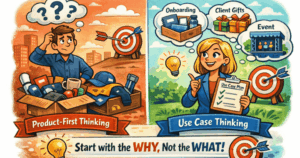
How to Budget for Corporate Swag Without Wasting Money
- Why Cost Per Item Is the Wrong Starting Point
- What a Corporate Swag Budget Should Consider
- What does value actually mean in a swag budget?
- Different Use Cases Require Different Budgeting
- Why Cheap Often Becomes Expensive
- Balancing Cost, Quality, and Scale
- Budgeting Becomes Easier With Structure
- A Practical Approach to Setting a Budget
- Closing Thought
A more effective corporate swag budget is not built around minimizing cost — it’s built around maximizing value over time.
Most companies approach merch budgeting in the simplest way possible:
How much does this cost per item?
While that feels logical, it often leads to poor decisions.
Why Cost Per Item Is the Wrong Starting Point
Cost per item is easy to compare.
However, it doesn’t capture what actually matters.
For example:
- a low-cost item that gets used once has little value
- a higher-quality item used daily creates repeated exposure
Because of this, focusing only on unit price can lead to:
- lower engagement
- wasted inventory
- missed brand opportunities
Instead of asking:
What is the cheapest option?
A better question is:
What creates the most value over time?
What a Corporate Swag Budget Should Consider
A well-structured corporate swag budget looks beyond upfront cost.
It accounts for:
- frequency of use → how often the item will be seen or used
- longevity → how long it will last
- perceived value → how it feels to the recipient
- relevance → how well it fits the use case
- distribution context → who receives it and why
Because of this, two items with the same price can produce very different outcomes.
What does value actually mean in a swag budget?
Value is not just financial.
It includes:
- how the item reinforces your brand
- how it affects employee or client perception
- how often it remains in use
As a result, value compounds over time, while cost is fixed upfront.
Different Use Cases Require Different Budgeting
Not all merch should be treated the same.
Each use case justifies a different level of investment.
For example:
Onboarding
- should feel intentional and consistent
- justifies moderate investment per person
- benefits from durable, everyday items
Events
- require higher volume
- benefit from simpler, cost-efficient items
- prioritize reach over longevity
Client gifting
- benefits from higher perceived value
- justifies premium investment
- depends heavily on timing and context
Because of this, a single budget approach rarely works across all scenarios.
Why Cheap Often Becomes Expensive
Low-cost merchandise often appears efficient.
However, it introduces hidden costs:
- items are unused or discarded
- brand perception is weakened
- replacement cycles happen more frequently
- engagement remains low
As a result, companies may end up:
- reordering more often
- spending more over time
- achieving less impact
In contrast, thoughtful investment reduces waste and increases effectiveness.
Balancing Cost, Quality, and Scale
A strong corporate swag budget finds balance.
Instead of choosing between:
- cheap vs expensive
It considers:
- where quality matters most
- where scale matters more
- where consistency is required
For example:
- premium items for smaller, high-impact audiences
- practical items for large-scale distribution
- consistent items for repeat internal use
Because of this, budgeting becomes more strategic and less reactive.
Budgeting Becomes Easier With Structure
When companies define:
- their core use cases
- their quality standards
- their expected volumes
Budgeting becomes predictable.
Instead of reacting to each request, teams can:
- allocate spend in advance
- justify decisions more easily
- reduce last-minute compromises
In practice, this leads to:
- better planning
- fewer rushed decisions
- more consistent outcomes
A Practical Approach to Setting a Budget
Rather than overcomplicating the process, start with:
- defining your primary use cases
- estimating volume for each
- assigning a value range per use case
- aligning expectations across teams
From there, refine based on:
- actual usage
- feedback
- outcomes
Because of this iterative approach, budgets become more accurate over time.
Closing Thought
Budgeting is not about spending less.
It’s about spending with intention.
When companies align cost with use case and value,
their corporate swag budget becomes a tool — not a constraint.
Next Chapter: How to Measure the Impact of Corporate Merch
Once budgets are set, the next question becomes:
Is any of this actually working?
In the next chapter, we break down how to think about ROI, measurement, and impact — without oversimplifying the results.
→ Continue to Chapter 6: Measuring Corporate Merch Impact
→ Go Back To Chapter 4: Start With the Use Case, Not the Product