What Your Merch Says About Your Company
- Branded Merchandise Is a Signal, Not a Giveaway
- How Merch Shapes Brand Perception Over Time
- Why Cheap Corporate Swag Impacts Your Brand
- Thoughtful Merch Signals Competence
- Consistency in Branded Merchandise Matters
- How Different Audiences Perceive Corporate Merch
- Merch Is One of the Few Physical Brand Touchpoints
- A Better Standard
- Closing Thought
A strong branded merchandise strategy is not about choosing products — it’s about understanding what those choices communicate.
Most companies don’t think of merch as communication.
They think of it as output.
Something to produce. Something to distribute. Something to check off a list.
But to the person receiving it, merch is not output.
It’s input.
It shapes how your company is perceived — often more subtly, and more honestly, than anything you say.
What is branded merchandise strategy?
Branded merchandise strategy refers to how companies use corporate swag and promotional products to shape brand perception, employee experience, and client relationships—not just distribute items.
Branded Merchandise Is a Signal, Not a Giveaway
Corporate merch is often framed as a “giveaway.”
That framing is the problem.
Giveaways imply:
- low stakes
- low attention
- low expectation
But branded merchandise doesn’t behave that way in the real world.
People don’t evaluate it like:
“Was this free?”
They evaluate it like:
“Was this thoughtful?”
“Was this useful?”
“Does this feel like the company that sent it?”
Every item becomes a signal.
Not because it was meant to be —
but because people naturally interpret it that way.
How Merch Shapes Brand Perception Over Time
Brand perception is not built through a single campaign.
It’s built through accumulation.
- how your emails feel
- how your website reads
- how your team communicates
- and yes — how your merchandise shows up
A low-quality item might seem insignificant in isolation.
But in context, it reinforces a pattern.
A well-made, relevant item does the same — in the opposite direction.
Neither is neutral.
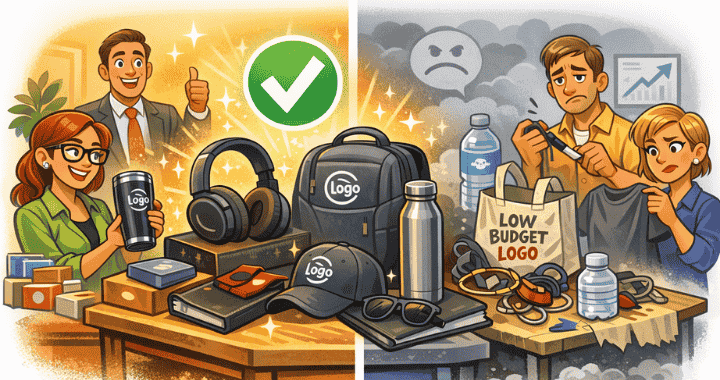
Why Cheap Corporate Swag Impacts Your Brand
Most companies justify low-quality merchandise with:
“It’s just swag.”
But that decision doesn’t stay contained.
It creates second-order effects:
- items are not used
- items are discarded quickly
- brand exposure disappears
- recipients disengage
And more importantly:
- it lowers the perceived standard of the company
This is where corporate merch strategy becomes a brand decision, not a purchasing one.
Because cost savings at the product level can translate into:
perception loss at the brand level
Thoughtful Merch Signals Competence
Well-executed merchandise doesn’t need to be expensive.
But it does need to be intentional.
When something is:
- relevant to the context
- aligned with the brand
- useful in real life
- designed with restraint
It signals something deeper:
this company pays attention
And attention is often interpreted as:
- competence
- professionalism
- reliability
Which are far more valuable signals than the item itself.
Consistency in Branded Merchandise Matters
Many teams over-index on being “creative” with merch.
Trying to stand out. Trying to be different.
But inconsistency creates confusion.
A better standard is:
- consistent tone
- consistent quality
- consistent decision-making
Because over time, consistency builds:
- familiarity
- trust
- recognition
This applies across all branded merchandise:
- onboarding kits
- client gifts
- event materials
- internal apparel
The goal is not to surprise people.
The goal is to reinforce what your company stands for.
How Different Audiences Perceive Corporate Merch
The same piece of merch will be interpreted differently depending on who receives it.
An employee might see:
- effort
- belonging
- investment
A client might see:
- positioning
- taste
- attention to detail
A prospect might see:
- credibility
- seriousness
- differentiation
This is why the question is not:
“Is this a good item?”
But:
“How will this be interpreted in this context?”
That is the core of a strong branded merchandise strategy.
Merch Is One of the Few Physical Brand Touchpoints
Most brand interactions today are digital.
Which makes physical touchpoints more important, not less.
A piece of merch:
- exists in real space
- lasts longer than a click
- can be used repeatedly
- can be seen by others
This gives it a different kind of weight.
When done right, it becomes:
- part of someone’s daily environment
- a subtle but repeated brand reminder
When done poorly, it disappears just as quickly as it arrived.
A Better Standard
Instead of asking:
“What should we order?”
A more useful question is:
“What do we want people to feel when they interact with our brand?”
Because merch is not just about distribution.
It’s about experience.
And experience is what shapes perception.
Closing Thought
Your brand is not just what you say.
It’s what people experience.
Corporate merch is one of the few places where that experience becomes tangible.
Which means it deserves the same level of thought as anything else that represents your company.
Next Chapter: Swag as a Program, Not a Purchase
If merch communicates something about your company,
the next question becomes:
How should it be managed over time?
In the next chapter, we break down the difference between:
- one-off orders
- and structured merch programs
And why companies that treat merch as a system consistently outperform those that don’t.
→ Continue to Chapter 3: Swag as a Program, Not a Purchase