What Corporate Merch Actually Is
Corporate merch is often misunderstood as “free stuff.”
Something you give away at an event.
Something you hand to a new hire.
Something you send to a client because it feels expected.
But that framing is shallow.
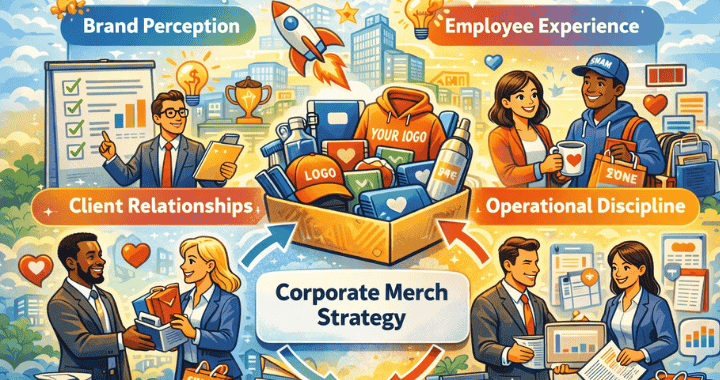
In reality, corporate merch sits at the intersection of:
- brand perception
- employee experience
- client relationships
- operational discipline
Which means it is not a side activity.
It is a reflection of how a company thinks.
What Is Corporate Merch in a Business Context
Corporate merch refers to branded products used by companies to support brand perception, employee experience, client relationships, and internal culture. It is not just promotional material, but a strategic business tool when used intentionally.
Corporate Merch Is Not the Product — It’s the Signal
A hoodie, a notebook, or a gift box is never just the object itself.
It carries signals.
It tells the recipient:
- how much thought went into this
- whether this was intentional or rushed
- whether the company understands who they’re giving it to
- what level of care and standard the company operates at
Most companies underestimate this.
They evaluate merch based on:
price, quantity, speed
But the recipient experiences it as:
quality, relevance, and intention
That gap is where most merch fails.
How Branded Merchandise Reflects Your Company
Whether you realize it or not, every piece of branded merchandise answers a question:
“What kind of company is this?”
Cheap, generic items tend to communicate:
- this was an afterthought
- this company optimizes for cost over experience
- this doesn’t really matter to them
Thoughtful, well-executed merch communicates:
- this company pays attention
- this was designed with a purpose
- there is a standard here
Neither message is accidental.
The Role of Corporate Merch Across a Business
One of the reasons companies struggle with merch is that it doesn’t belong to a single function.
It touches multiple parts of the business:
- HR uses it for onboarding and culture
- Marketing uses it for campaigns and events
- Sales uses it for relationships and follow-ups
- Operations manages logistics and delivery
Because of this, merch often becomes fragmented:
- different teams making different decisions
- inconsistent quality
- duplicated effort
Without a clear way of thinking about it, it turns into:
a series of disconnected purchases
Instead of:
a coherent system
Corporate Merch Strategy Requires Operational Discipline
Behind every piece of merch is a chain of decisions and execution:
- what to choose
- how to brand it
- how much to order
- when it’s needed
- where it needs to go
- how consistently it’s delivered
Companies that treat merch casually tend to:
- rush decisions
- miss timelines
- settle for what’s available
Companies that treat it as a system:
- plan ahead
- maintain consistency
- reduce friction over time
The difference is not creativity.
It’s discipline.
Why Most Companies Get Corporate Merch Wrong
Most companies don’t fail because they choose the “wrong product.”
They fail because:
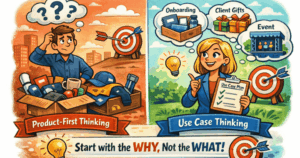
- they start with the item instead of the intent
- they optimize for cost instead of value
- they treat merch as a one-off task
- they don’t define a standard
Which leads to:
- wasted budget
- unused items
- inconsistent brand experience
The result isn’t just inefficiency.
It’s a missed opportunity.
A Better Way to Think About It
Before choosing products, suppliers, or budgets, companies need to reframe the role of merch entirely.
A strong corporate merch strategy starts with one idea:
Merch is a business tool, not a leftover budget category.
Used intentionally, it can:
- reinforce brand identity
- improve employee experience
- strengthen client relationships
- create consistency across the company
Used casually, it becomes:
- clutter
- cost
- noise
Closing Thought
The difference is not what you buy.
It’s how you think.
And once that shifts, everything else — products, budgets, execution — becomes easier to get right.
Next Chapter: What Your Merch Says About Your Company
If merch is a signal, the next question becomes:
What is your company actually communicating?
Every item you put your logo on — intentionally or not — shapes perception.
In the next chapter, we break down how corporate merch influences:
- how your brand is seen
- how your standards are interpreted
- and why cheap, generic choices often cost more than they save
→ Continue to Chapter 2: What Your Merch Says About Your Company