Swag as a Program, Not a Purchase
- Why One-Off Merch Purchases Break Down
- What a Corporate Merch Program Actually Is
- From Campaign Thinking to a Merch Program
- How a Corporate Merch Program Builds Consistency
- Why Merch Program Structure Improves Operations
- Where Corporate Merch Programs Fail
- A Practical Way to Build a Merch Program
- Closing Thought
- Next Chapter: Start With the Use Case, Not the Product
Most companies don’t have a corporate merch program.
They have orders.
A request comes in.
A deadline appears.
Something gets sourced, approved, and shipped.
Then it ends.
However, this approach creates inconsistency over time. Different teams make different decisions, quality varies, and the overall experience becomes fragmented.
A strong corporate merch program solves this by replacing reactive buying with structured thinking.
Why One-Off Merch Purchases Break Down
At first, ordering merch as needed feels efficient.
There’s no long-term commitment. No upfront planning. No system to maintain.
However, over time, the cracks begin to show:
- items feel disconnected from each other
- branding becomes inconsistent
- teams duplicate effort
- timelines get rushed
- quality becomes unpredictable
More importantly, the company loses control over how it presents itself.
Because merch isn’t centralized, it becomes:
a series of decisions instead of a coherent system
What a Corporate Merch Program Actually Is
A corporate merch program is not about ordering more.
Instead, it’s about creating structure.
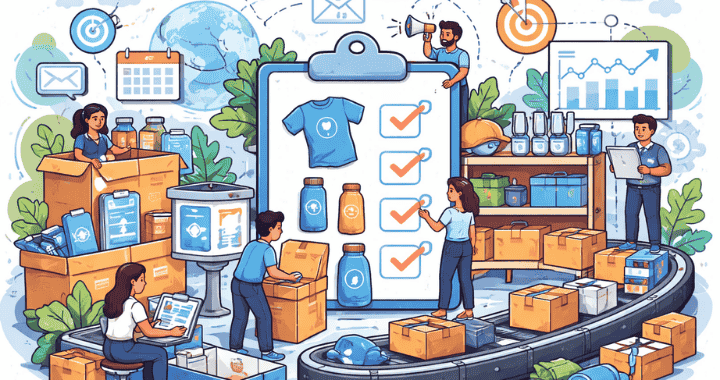
A well-designed program typically includes:
- defined use cases (onboarding, events, client gifting)
- a consistent quality standard
- a curated set of approved items
- centralized sourcing and vendor management
- repeatable ordering and fulfillment processes
As a result, decisions become easier, faster, and more consistent.
Teams no longer start from zero each time. They operate within a framework.
From Campaign Thinking to a Merch Program
Many companies approach merch like a campaign:
- one event
- one shipment
- one moment
While this works in isolation, it doesn’t scale.
A program-based approach shifts the mindset:
- from one-time → to repeatable
- from reactive → to planned
- from scattered → to consistent
Because of this, the company builds:
- recognition
- internal alignment
- operational efficiency
The difference is subtle at first, but significant over time.
How a Corporate Merch Program Builds Consistency
Consistency is often underestimated in branded merchandise.
However, it is one of the most important drivers of long-term value.
When teams repeatedly use:
- similar quality levels
- aligned product categories
- consistent branding
It creates familiarity.
That familiarity builds:
- trust internally
- recognition externally
- confidence in the brand
In contrast, inconsistent merch weakens perception — even if each individual item seems acceptable.
Why Merch Program Structure Improves Operations
A merch program doesn’t just improve output.
It simplifies operations.
Instead of:
- searching for products every time
- re-evaluating vendors
- managing last-minute timelines
Teams can:
- reorder quickly
- rely on known standards
- execute without friction
In practice, this reduces:
- time spent on decisions
- stress around deadlines
- risk of poor outcomes
Which means merch becomes easier to manage — not harder.
Where Corporate Merch Programs Fail
Even when companies try to build a system, they often fall into common traps:
- overcomplicating the structure
- trying to include too many options
- failing to define clear standards
- not aligning across teams
As a result, the “program” becomes:
another layer of confusion
A strong program is not complex.
It is:
- clear
- focused
- repeatable
A Practical Way to Build a Merch Program
Instead of building a large system upfront, a better approach is to start small:
- define 2–3 core use cases
- select a tight set of reliable items
- establish a consistent quality level
- align internal stakeholders
From there, the system can expand naturally.
Because it is grounded in real use, it stays relevant.
Closing Thought
The difference between buying merch and running a program is not scale.
It’s structure.
One creates activity.
The other creates consistency.
And over time, consistency is what turns merch from a cost into a meaningful part of how a company operates.
Next Chapter: Start With the Use Case, Not the Product
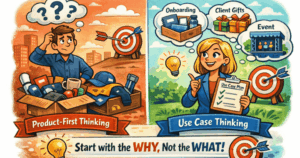
Once a program exists, the next challenge is decision-making.
How do you choose what actually belongs in it?
In the next chapter, we break down why most companies start with the wrong question — and how shifting to use-case thinking leads to better outcomes.
→ Continue to Chapter 4: Start With the Use Case, Not the Product
→ Go Back To Chapter 2: What Your Merch Says About Your Company