Start With the Use Case, Not the Product
- Why Product-First Thinking Leads to Poor Decisions
- What a Use Case Means in a Corporate Swag Strategy
- What does a use case in merch actually define?
- How Use Case Thinking Improves Merchandise Decisions
- Why Companies Default to Generic Swag
- Clarity Creates Better Outcomes
- Consistency Comes From Defined Use Cases
- A Practical Way to Apply Use Case Thinking
- Closing Thought
A strong corporate swag strategy does not begin with what you buy — it begins with why you need it.
Without that clarity, even good products can fail to create meaningful outcomes.
However, most companies approach merch decisions the same old way.
They start by looking at products.
Why Product-First Thinking Leads to Poor Decisions
At first glance, choosing products feels like progress.
You compare options, evaluate pricing, and select something that looks acceptable.
However, this approach ignores context.
Because of that, the same product can perform very differently depending on the situation.
For example:
- a hoodie may work well for internal teams
- but feel misaligned in a client gifting context
- or unnecessary for a short-term campaign
The issue is not the item itself.
Instead, the issue is that the decision was made without a defined purpose.
What a Use Case Means in a Corporate Swag Strategy
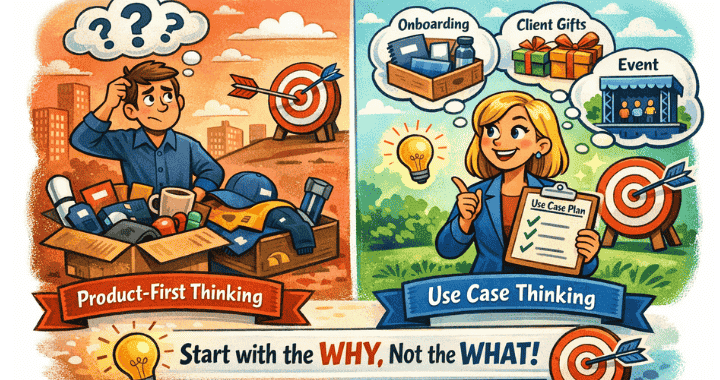
A use case defines the role merch is expected to play.
In other words, it answers:
What outcome are we trying to create?
Common use cases include:
- onboarding new employees
- running events or conferences
- strengthening client relationships
- supporting internal culture
- enabling sales outreach
Each use case introduces different requirements.
As a result, decisions around:
- product type
- quality level
- branding approach
- and delivery
should all change accordingly.
What does a use case in merch actually define?
A clearly defined use case determines:
- who the audience is
- how the item will be used
- how long it should last
- what impression it should create
Because of this, use case clarity removes guesswork.
How Use Case Thinking Improves Merchandise Decisions
Once the use case is established, decisions become more structured.
Instead of asking:
What should we order?
The question becomes:
What experience are we trying to create?
For example:
Onboarding
- should feel intentional and consistent
- benefits from practical, everyday items
Events
- prioritize visibility and accessibility
- require higher volume and simplicity
Client gifting
- requires relevance and timing
- benefits from higher perceived value
Because these goals differ, the merchandise should differ as well.
Why Companies Default to Generic Swag
When use case thinking is missing, companies tend to choose safe options.
For example:
- mugs
- pens
- basic apparel
While these are easy to source, they often lack impact.
This happens because:
- they are selected without context
- they are not tied to a specific goal
- they prioritize convenience over relevance
As a result, they tend to be:
- underused
- quickly forgotten
- disconnected from the brand experience
Clarity Creates Better Outcomes
A clear use case simplifies decision-making.
Instead of navigating hundreds of options, teams can focus on what actually matters.
Because of this:
- product selection becomes faster
- budgets become easier to justify
- outcomes become more predictable
More importantly, decisions begin to align with business objectives rather than personal preference.
Consistency Comes From Defined Use Cases
When companies define their use cases clearly, they can standardize their approach.
For example:
- onboarding follows a repeatable structure
- events follow a consistent playbook
- client gifting aligns with relationship stages
Over time, this creates:
- alignment across teams
- consistent brand experience
- reduced operational friction
In contrast, product-first decisions often lead to inconsistency.
A Practical Way to Apply Use Case Thinking
Rather than building a complex system immediately, start with a few core scenarios.
Define:
- your primary use cases
- the audience for each
- the intended outcome
Then align your decisions accordingly.
For example:
- onboarding → focus on consistency and usability
- events → focus on reach and visibility
- client gifting → focus on relevance and perception
This creates a foundation that can scale over time.
Closing Thought
Products are easy to compare.
However, without context, comparison doesn’t lead to better decisions.
Use cases provide that context.
When companies start with intent instead of items,
their corporate swag strategy becomes more focused, consistent, and effective.
Next Chapter: How to Budget for Merch Like a Business
Once use cases are defined, the next challenge becomes allocation.
How much should you spend — and where does it matter most?
In the next chapter, we break down how to think about cost, value, and tradeoffs in a way that aligns with real business goals.
→ Continue to Chapter 5: How to Budget for Merch Like a Business