The Corporate Merch Playbook: How Modern Companies Should Think About Swag, Gifting, and Brand
- 1. What Corporate Merch Actually Is
- 2. What Your Corporate Merch Strategy Says About Your Company
- 3. Corporate Merch as a System, Not a Purchase
- 4. Start With the Use Case, Not the Product
- 5. Budgeting: Cost vs Value
- 6. Understanding ROI (Without Oversimplifying It)
- 7. Employee Experience and Internal Culture
- 8. Client Gifting as Corporate Merch Strategy
- 9. Quality, Waste, and Standards
- 10. Execution Is the Hard Part
- 11. Different Teams, Different Goals
- 12. Premium vs Practical
- 13. Choosing the Right Partner
- 14. Common Corporate Merch Strategy Mistakes Companies Make
- 15. A More Thoughtful Standard
- Closing Thought
Most companies don’t have a corporate merch strategy.
They have moments.
A trade show coming up.
A new hire starting.
A client to impress.
So they buy something. Usually quickly. Often cheaply. Almost always without a framework.
And that’s where things go wrong.
Because corporate merchandise is not just a purchase.
It’s a signal. A system. A reflection of how a company thinks.
Used poorly, it becomes clutter.
Used well, it becomes part of how a company operates, communicates, and builds relationships.
This guide is not about what to buy.
It’s about how to think.
1. What Corporate Merch Actually Is
Corporate merch is often misunderstood as “free stuff.”
In reality, it sits at the intersection of:
- brand perception
- employee experience
- client relationships
- operational discipline
A hoodie, a notebook, or a gift box is never just the object.
It represents:
- how much thought was put in
- how well the company understands its audience
- what standard the company holds itself to
Before choosing products, companies need to understand corporate merch strategy:
merch is a business tool, not a leftover budget category
→ Read more: What Corporate Merch Actually Is
2. What Your Corporate Merch Strategy Says About Your Company
Every item you put your logo on communicates something.
Cheap, disposable items signal:
- short-term thinking
- lack of care
- low internal standards
Thoughtful, well-designed merchandise signals:
- clarity
- taste
- consistency
- respect for the recipient
The question is not:
“Is this a good product?”
The question is:
“What does this say about us?”
→ Read more: What Your Merch Says About Your Company
3. Corporate Merch as a System, Not a Purchase
Most companies treat merch as a one-off.
The more mature approach is to treat it as a program.
A system includes:
- repeatable use cases
- consistent quality standards
- centralized sourcing
- planned inventory or fulfillment
This reduces:
- decision fatigue
- inconsistency
- rushed, poor purchases
And it increases:
- efficiency
- brand alignment
- long-term value
→ Read more: Swag as a Program, Not a Purchase
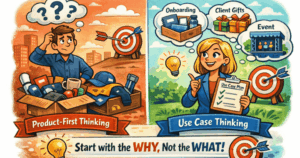
4. Start With the Use Case, Not the Product
The biggest mistake companies make is starting with the item.
“Let’s get mugs.”
“Let’s do hoodies.”
Instead, start with intent:
- Is this for onboarding?
- Is this for an event?
- Is this for client relationships?
- Is this internal culture?
The same product can be:
- perfect in one context
- completely wrong in another
Use case defines everything.
→ Read more: Start With the Use Case, Not the Product
5. Budgeting: Cost vs Value
Most teams think about merch in terms of:
cost per unit
That’s incomplete.
A better framework considers:
- how long the item will be used
- how often it will be seen
- how it reflects on the brand
- whether it will actually be kept
A $5 item used once is more expensive than a $40 item used daily.
Good budgeting is not about minimizing spend.
It’s about maximizing relevance and longevity.
→ Read more: How to Budget for Merch Like a Business
6. Understanding ROI (Without Oversimplifying It)
Not all merch has direct ROI.
But that doesn’t mean it has no value.
ROI in merch can show up as:
- increased event engagement
- stronger client relationships
- better onboarding experiences
- improved employee sentiment
- higher brand recall
Some outcomes are measurable.
Others are cumulative.
The mistake is forcing everything into:
“Did this item generate revenue?”
The better question is:
“Did this improve how people experience our company?”
→ Read more: How to Think About Corporate Merch Impact
7. Employee Experience and Internal Culture
Merch plays a quiet but important role in culture.
Good merch can:
- make new hires feel welcomed
- reinforce belonging
- create internal identity
Bad merch does the opposite:
- it gets ignored
- it gets discarded
- it signals indifference
Companies often invest heavily in hiring and branding,
but overlook the physical experience of joining and being part of the team.
That gap matters.
→ Read more: How Merch Shapes Employee Experience
8. Client Gifting as Corporate Merch Strategy
Client gifting is often treated as an obligation.
Done properly, it’s a strategy.
It’s not about:
- the price of the gift
- the size of the box
It’s about:
- timing
- relevance
- thoughtfulness
A well-timed, well-chosen gift can:
- reopen conversations
- strengthen relationships
- differentiate your company
Generic gifts rarely do.
→ Read more: Client Gifting as Relationship Strategy
9. Quality, Waste, and Standards
One of the biggest issues in the merch industry is waste.
Cheap items:
- break
- get discarded
- are never used
This creates:
- unnecessary cost
- environmental waste
- brand damage
Quality is not about luxury.
It’s about:
- usefulness
- durability
- intention
A thoughtful approach reduces waste and improves perception.
→ Read more: Quality and Ethics in Corporate Merchandise
10. Execution Is the Hard Part
Most companies underestimate how complex merch execution is.
Behind every “simple” order is:
- sourcing
- sampling
- approvals
- branding
- timelines
- logistics
- delivery coordination
At scale, this becomes operationally heavy.
This is why many companies struggle:
not with ideas, but with execution.
→ Read more: Why Merch Execution Is Harder Than It Looks
11. Different Teams, Different Goals
Merch is not one thing across a company.
- HR uses it for onboarding and culture
- Marketing uses it for campaigns and events
- Sales uses it for relationships
- Operations manages logistics
Each function has:
- different goals
- different expectations
A single, unified approach rarely works.
Understanding these differences is key to building a system that actually functions.
→ Read more: How Different Teams Should Think About Merch
12. Premium vs Practical
Not every situation requires premium merchandise.
But not every situation should default to cheap options either.
The right decision depends on:
- audience
- context
- frequency of use
- brand positioning
The goal is not to always spend more.
The goal is to spend appropriately.
→ Read more: When Premium Merch Makes Sense
13. Choosing the Right Partner
Most companies don’t need more product options.
They need:
- better guidance
- reliable execution
- consistent quality
A good merch partner:
- asks better questions
- understands use cases
- manages complexity
- delivers consistently
The difference between a vendor and a partner is not price.
It’s judgment and reliability.
→ Read more: How to Choose a Merch Partner
14. Common Corporate Merch Strategy Mistakes Companies Make
Across industries, the same patterns repeat:
- starting with products instead of goals
- choosing based on price alone
- underestimating timelines
- ignoring internal use cases
- treating merch as an afterthought
These mistakes are avoidable.
But only with a better framework.
→ Read more: Common Corporate Merch Mistakes
15. A More Thoughtful Standard
Corporate merch doesn’t need to be complicated.
But it does need to be intentional.
The companies that do this well:
- think in systems
- prioritize quality over volume
- understand their audience
- execute consistently
Merch, at its best, becomes:
- part of the brand
- part of the culture
- part of how the company shows up
Closing Thought
If you’re thinking about merch, you’re already making decisions.
The question is whether those decisions are:
- reactive
- or intentional
If you want to approach it more thoughtfully,
it helps to have the right structure in place.